Monday, June 17, 2013

Customer Dissatisfaction and Colossians

Customer satisfaction. It’s a given in our culture. Companies and businesses go to significant lengths to ensure their customers are satisfied. If you call with a question you do not speak to ‘customer service’, if you are fortunate to actually talk to a person these days it is with a ‘customer satisfaction specialist’. The reason: satisfied customers come back, and it is a key part of business models and a force in our economy. Satisfaction guaranteed.


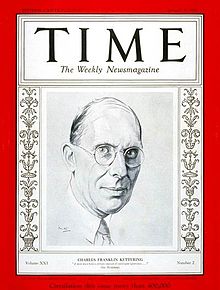
However, there is also a much stronger and much more subtle force at work in our world, one which we are likely unaware. In fact I was not even aware of it until a few weeks ago when a parishioner loaned me a biography of Charles F. Kettering, the innovative and indefatigable inventor and engineer of Dayton, after whom the town of Kettering is named. In this biography, Boss Kettering: Wizard of General Motors, there is a chapter called “Customer Dissatisfaction”. In it, Kettering establishes the concept that the auto industry would succeed financially only if their customers were actually perpetually dissatisfied. Not in the sense customers were to be unhappy with the cars they bought, and certainly not that Kettering wanted to make a substandard product. His point being that the industry needed to tap into people’s desire to want something better than what they already had – to be ‘dissatisfied’ with what they currently owned in order to want the next, newer version. Thus Kettering was instrumental in establishing the auto industry practice of cranking out a new model version every single year. What is remarkable is that Kettering was making these observations and arguments some 90 years ago.


Kettering’s point reveals that we live in a constant state of dissatisfaction. How many times do we buy something new, not because the current version we have is broken or defective, but simply because a newly innovated, updated version has just come out? Retail therapy anyone? How much energy and resources do industries and businesses put towards sustaining and tapping into our innate sense of dissatisfaction, convincing us we must have things we don’t really need. What I find most striking is that many of us are consciously unaware of this sense of dissatisfaction.


While this sense of dissatisfaction is readily connected to technology, it is nothing new, nor limited only to
commercial consumption. Religion falls prey to dissatisfaction as we seek newer ways to get a better “God-experience”. Even in the ancient world people were keen to 1-up to the next religious idea or fad. Such was the case in the city of Colossae, to which St. Paul wrote a letter guiding them to not fall prey to the latest philosophies and religious ideas that were part of the first century spiritual stew of the Roman Empire.


Paul admonishes the Colossians to make sure that “no one takes you captive by philosophy and empty deceit, according to human tradition” (2:8). He wanted them to not chase after religious practices and observances to be better Christians, and so feed their sense of dissatisfaction. Instead he urges them to be satisfied with Jesus Christ. In Colossians Paul gives us some of the grandest and richest descriptions of Christ in all the New Testament. “For in him all the fullness of God was please to dwell” (1:19). There is no one greater than Jesus, the God-Man, and nothing sweeter than his Gospel, and yet, as Augustine pointed out, “Our hearts are restless, until they rest in Thee.” Learning to be satisfied in life is a constant challenge, and certainly part of our life of faith we are to learn to be satisfied with God’s saving grace in Christ. During July we will be reading through Paul’s letter to the Colossians. May we heed its glorious presentation of Jesus Christ, and learn from its sacred message to die to our dissatisfaction and trust in and be satisfied with Christ alone – for all else will leave us wanting.


Tuesday, May 28, 2013

Crux sola est nostra theologia – the Cross alone is our theology. This phrase was coined by Martin Luther, the great Protestant Reformer, almost five hundred years ago. Not that the Cross is the only thing Christians ever think about, far from it, but Luther’s point is that a right understanding of the Cross of Jesus (that is, his death, resurrection, and ascension) is essential to understanding Christianity. Luther pointed out that in the realm of ideas, of philosophies, literature, culture, religions and spiritualities, there are essentially one of two stories being told. The first is what he called a theology of glory, which is characterized by the upward struggle of the soul to attain to righteousness. A theology of glory appeals to our own sense of accomplishment, and while admitting we may not be perfect, seeks to spur us on to bigger and better things. When this theology of glory is applied to the Christian Gospel, the result is often simply Good Advice, rather than Good News. It ultimately leads us to ruin because the glory story fails to account for our inability to attain to that which it points, even if what we are striving for is good.


Contrasting this theology of glory is what Luther calls a theology of the cross. In this story sinners do not climb to heaven, but rather Heaven comes down to earth as a Perfect Person, Jesus Christ, who alone is able to rescue and save sinners. The story of the cross does not appeal to our sense of accomplishment, instead it holds up a mirror to our true nature and reveals out innate need of a Savior. This is at the same time horrible and life giving. Horrible because it shows that, as the old Prayer Book confessions put it, ‘there is no health in us’. It calls a spade a spade.

It is life-giving because in the Gospel a message is given to sin-sick souls that something has already been done to cleanse, forgive, restore, justify, and ultimately glorify them. The rub is that we sinners had nothing to do with it, and we just don’t like that part! That is why it is by God’s grace. In his letter to the Galatians, St. Paul declares, “I do not nullify the grace of God, for if righteousness came through the Law, then Christ died for nothing” (2:21).To put it in Luther’s terminology, if the Glory Story worked, then we have no need of Jesus on the Cross. If we are helpless, and can see our own helplessness, then we have every need of a crucified and risen Savior.

The cross story creates faith in Christ, the glory story creates faith in ourselves.


As we enter the season of Pentecost, the longest season of the church year, our worship orients itself to the ongoing work of Christ through the Holy Spirit. Those who are in Christ are led by his Spirit to preach the Gospel, heal the sick, pray together, sing together, live together, and learn together. It is perhaps fitting that during the first part of Pentecost, through June and July, we will be reading from St. Paul’s letter to the Galatians. This short letter is packed with the Apostle’s fiery explanation of the importance of the theology of the Cross. The work of the Spirit of life and freedom brings our life and our story into the story of the Cross, not the other way around (which is the glory story). “For I have been crucified with Christ, and I no longer live but it is Christ who lives in me; the life I live in the flesh I live by faith in the Son of God who loves me and gave his life for me” (2:20).
Luther's ideas did not arise in a vacuum, but from reading Scripture and having a gift at distilling the concepts of the Bible in clear terms. If you have never read Galatians, give it a shot. If you have, try reading it again and see if you can track with Paul's thinking regarding a theology of glory versus a theology of the cross.
Crux sola est nostra theologia.

Thursday, July 26, 2012

Can't and Can

I came across a very interesting quote from, of all people, Lucille Ball:

"Knowing what you can't do is much more important than knowing what you can."

Quite a profound thing to say. We readily hone our skills, know our strengths, and play to those strengths. And while this is all certainly good (who goes to a job interview and hopes to share with their prospective employer what they can't do), I believe one of the hardest things to do in life, and one of the gifts of maturing, is to know with clarity and honesty what you simply can't do, and not live in denial, but to make peace with what you can't do.

This is true in life as it is true with God. We simply can not by our own efforts commend ourselves to God. A tough pill to swallow, but embracing this reality opens the door to faith in the One who Can. The gap between us and God has not been filled by our efforts, we Can't, but by Jesus who Can. He has met all of God's righteous requirements, has not failed, and loved to the last and paid the price of blood for those who Can't.

What the Gospel does is it not only frees us from running from our failures, but also through Christ means we no longer are defined by what we Can't Do. Trusting in Christ doesn't mean that you automatically become a superhero who can do anything you put your mind to. What it means is that your are loved in the face of your failure not because you have succeeded. And that will in fact change you.

Know Thyself, Know Thy Limits. But know Thy Lord.

Wednesday, May 30, 2012

How Does He Do That!

So for a guy who likes beer, and even brews his own, and is a Mac user (no, not a crazy, over-the-top-Mac-is-my-Master Mac user, I just have a computer that happens to be Mac. And an iPhone. And an iPod. But hey who doesn't these days anway. Where was I. Oh, right, beer). So for a guy who likes Macs and brews his own beer, this video was for me - maybe I should get an iPad after all. Enjoy!

Monday, January 9, 2012

Cell Phones In Church

A parishioner sent this to me. Love the concept, not sure how we'd be able to implement it though!

Saturday, August 6, 2011

John Stott: The most influential evangelical you've never heard of


Last Wednesday (July 27th) John Stott passed away at the age of 90 in Surrey, England. But who is John Stott and what's the big deal anyway. John Stott was ordained in 1945 as a minister in the Church of England, and has had an enormous influence on Christianity all over the world. He's written over 50 books, ranging in style from popular/devotional to academic commentaries, history and theology. He was appointed Chaplain to the Throne by Queen Elizabeth and founded numerous organizations, many of which focus on global ministry, particularly in the Global South. He spent a good portion of his ordained ministry as the Vicar of All Soul's, Langham Place in London, and was appointed Vicar-Emeritus after his retirement. Here's an article from the New York Times written about his life and death.

But what makes Stott so interesting and his death so notable, is that he represented a type of evangelical very unlike what most of the 21st century West has (sometimes rightly) grown to despise about evangelicals in general: he was incredibly gracious and humble. He was passionate about evangelism and Gospel proclamation, biblical faithfulness, and a global understanding of the church. He met with heads of state, global leaders, and people of influence for seven decades, and did so with poise, humbleness, and tenacity.

Sadly, when most people hear "evangelical" they think of 'angry, thoughless, close-minded, fundamentalist'... etc., and unfortunately they don't think of all the things that Stott embodied: thoughtful, exceptionally intelligent, faithful, gracious, and humble, while still maintaining an integrity with his convictions.

The category of global evangelical leader is often readily filled with names like Billy Graham, but, to quote the NYT, "For all his fame on several continents, Mr. Stott’s travels and appearances were remarkably devoid of pomp, befitting his simple message of reason and faith and his unassuming demeanor. Those in his ministries knew him simply as Uncle John. In his later years, he lived in a two-room apartment over the garage of a London rectory, and for many years he kept a small cottage on the Welsh coast, where he did much of his prodigious writing in longhand and, until 2001, without electricity."

I never met Rev. Stott, but I wish I had. I grew up hearing his name and have read many of his books (see below for a list of some of his more well known writings). But I know that he lead, preached, inspired, guided, and formed many thousands of Christians and Christian leaders over the better part of the twentieth century. Most Episcopalians have never even heard of him. So for one of the most remarkable and influential Christian leaders of our time, I bow my head at news of his death, and close with a quote from the President of John Stott Ministries who succinctly and simply sums up Stott's life: "He imparted to many a love for the global church and imparted a passion for biblical fidelity and a love for the Savior."

O God, who by thy Holy Spirit dost give to some the word of
wisdom, to others the word of knowledge, and to others the
word of faith: We praise thy Name for the gifts of grace
manifested in thy servant John, and we pray that thy Church
may never be destitute of such gifts; through Jesus Christ our
Lord, who with thee and the Holy Spirit liveth and reigneth,
one God, for ever and ever. Amen. (Book of Common Prayer, p. 197)

Some noteworthy books by John Stott:

The Cross of Christ
The Message of Romans (Bible Speaks Today Commentary Series)
Basic Christianity
The Preacher's Portrait
The Contemporary Christian
Romans: God's Good News for the World


Friday, April 22, 2011

Bad Friday?


Good Friday. What an odd title for such a day as this. For on this day the Prince of Glory was abused and suffered a travesty of justice, a farce of a trial, and was hauled outside Jerusalem like a common criminal. There on a desolate hill appropriately named The Skull he was put to the most shameful and painful death the ancient world had at its disposal. And yet we call this day “Good”. How can that be – should this not be “Bad Friday”?

In many respects it is bad, for on this day we see humanity at its worst. God finally arrived on earth as a fully Incarnate man, and the path of his life lead not to victorious glory but a painful, humiliating death. How ironic that the Good of Jesus brought out the Worst in People. Yes, when we look at the cross we see ourselves at our worst – the offense of the Cross of Jesus is that it exposes human sin. Things really are this bad. Judas asked, “Is it I?” who would betray Jesus, and on Good Friday we ask ourselves, “Is it I?” who put him on the cross?

But the mystery and power of God’s redemption is that, “By his blood he reconciled us, and by his wounds we are healed” (BCP p. 370, para. Isaiah 53:5). On this bad and terrible day, unbeknownst to all those gathered on Golgotha, God was actually doing something Good. Something he had promised from ages past that would undo all the sorrowful, hurtful, wrong things of this world. God would forgive sins, wash away sorrow and guilt, and begin a New Creation. The offense of the cross is that it exposes human sin – the glory of the cross is that it also washes away human sin. God did all of this out of his great love for us at our worst (not our best!). All it cost was the life of the Lamb of God who takes away the sin of the world